Tower Rush slot: play for real money at online casinos
Just a handful of words describes any Tower Rush round. Learn what a floor does, why value and danger climb together, how manual and automatic collection work, and what changes once a special floor appears. The return band, stake settings, demo access and safer play tools are laid out plainly, with no promise of winning and no shortcut around pure chance.
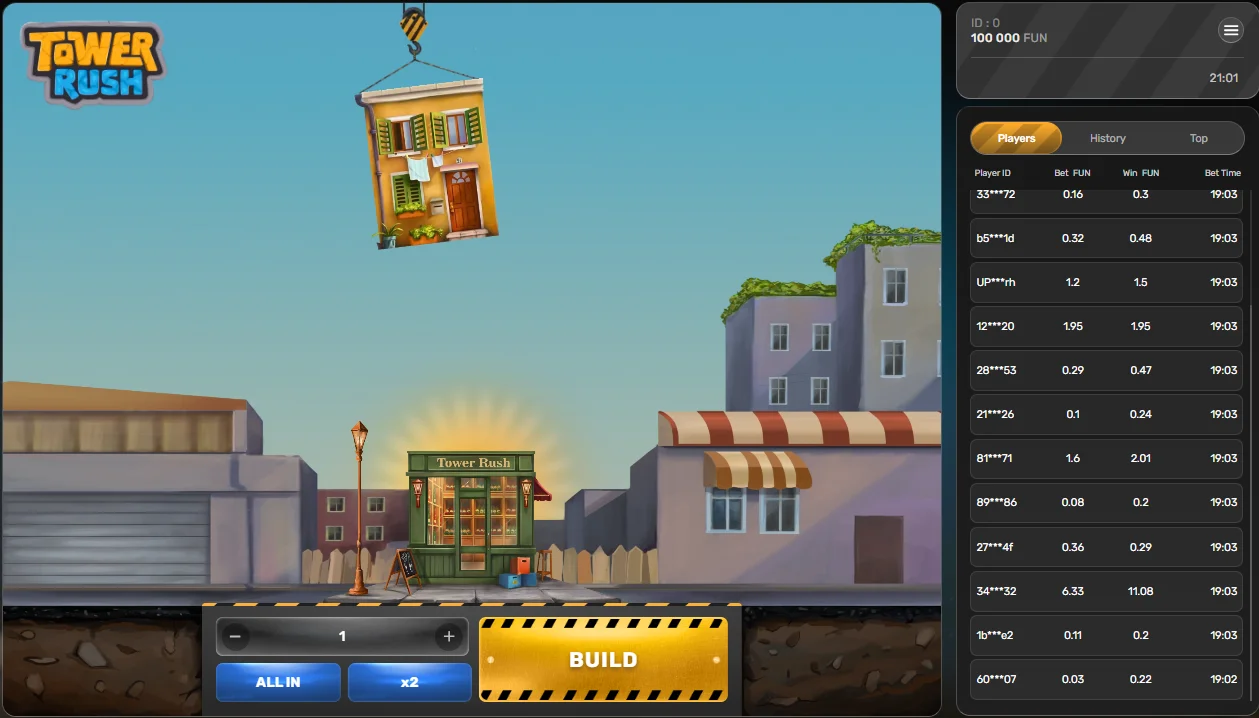
Explore the game with simulated funds — no signup needed.
Experience intense moments in Tower Rush, a crash game where you monitor multipliers and cash out to secure your winnings. Test the demo today!
In Summary: Tower Rush is a crash game developed by Galaxsys, featuring medium to high volatility and an RTP that ranges from ninety-six point two to ninety-seven point five percent. With stakes varying from zero point one to one hundred, players can maximize their experience by aiming for a one hundred times multiplier in this engaging single-player mode.
| Title | Tower Rush |
| Launch date | Jun 12, 2026 |
| Wager range | 0.1 - 100 |
| Game type | Crash-style game |
| Game creator | Galaxsys |
| Risk level | Medium-high |
| RTP | 96.2–97.5% |
| Top prize | x100 |
How does a crash work
Comment se déroule une session de jeu
Commencez par placer votre mise, puis regardez la tour commencer à se construire, augmentant le multiplicateur avec chaque étage ajouté.Comment placer votre mise
Gardez un œil sur la structure grandissante tout en décidant quand retirer pour obtenir le meilleur retour.Comment fonctionne le jeu
Les sessions de jeu se terminent une fois que la tour s'effondre ou que vous retirez avec succès.
Floor, multiplier, collapse, cash-out. Those four words carry almost everything Tower Rush asks of you, and once they click, each Tower Rush round reads like a short sentence with a single decision in it.
Play opens on bare ground. Storeys are added in sequence, the multiplier climbs with every addition, and the structure may give way anywhere along the climb. Your part is to judge when the stacking should stop and the winnings should be collected.
That is the whole loop. What surrounds it, such as three special floors, a return figure published as a band rather than a single number, stake settings chosen by each casino and a free demo, makes more sense once the vocabulary is in place.
So the page runs in that order: a compact glossary first, then a short explanation for each term, then the practical side, meaning where the game can be played, which details sit inside each version's rule sheet, and the habits that stop a quick game from taking over an evening.
Nothing below is a method for winning. Outcomes are random, and every section treats them that way.
Key terms of Tower Rush in one table
Nine words cover the mechanics. Read down the left column once and the remaining sections will feel familiar.
| Term | Meaning in Tower Rush |
|---|---|
| Plot | Empty ground at the start, before any building begins |
| Floor | One added storey; every new one lifts the multiplier |
| Multiplier | What your stake gets multiplied by if you collect right now |
| Collapse | The tower falling while your money is still riding on it, so that stake is gone |
| Cash-out | Collecting stake times multiplier, which ends play for that tower |
| Auto cash-out | Collection that fires by itself when a preset target figure is hit |
| Special floor | Triple Build, Frozen Floor or Temple Floor, each altering what happens next |
| RTP | Return to player; the band Galaxsys publishes runs from a low of 96.2% to a high of 97.5% |
| Stake | Money put on one attempt; the casino's own settings decide it, from R 2 at minimum up to R 2 000 |
Several of these terms lean on each other. A multiplier means nothing without storeys underneath it, and cashing out only exists because a fall is possible. Remove that danger and nobody would ever stop.
Of all nine rows, only the stake is something you set directly before play. Everything else either happens to the tower or is fixed by whichever version the operator runs.
Two entries also point beyond any single tower. RTP is a long-run measure taken over vast quantities of play, and the stake band is something the operator configures, not the studio alone. Both get fuller treatment further down, but neither tells you anything about what the next build will do.
One last note: the glossary borrows its vocabulary from the official rule sheet, so each paragraph there should map neatly onto a row here.
Floors and the Tower Rush multiplier
Each new floor works in two directions. It lifts the multiplier, and it raises the odds that whatever gets added next turns out to be fatal.
That pairing sits at the heart of Tower Rush. Height adds value and fragility together. No storey exists where reward keeps growing while danger holds still.
Think of a round as a short series of offers. Storey one comes with a modest multiplier. Storey two offers slightly more, alongside a slightly worse chance of reaching storey three. Every rung up trades a little safety for a little extra payout.
How tall the previous tower grew changes nothing here. Each new attempt begins from nothing, and that link between height and danger resets with it.
The multiplier also stays hypothetical until you collect. Up to that point it simply describes what stopping would pay at this instant. An impressive figure on a structure that later topples pays zero.
Newcomers often treat the rising number as money already banked. It reads better as a standing offer that vanishes once the tower goes.
So the useful habit is modest: pick an approximate height you are comfortable with before anything is built, since choices made mid-climb, with the figure ticking upward, are where most hasty calls come from.
Collapse and lost stakes
When the tower comes down, play stops on the spot. Without a cash-out beforehand, whatever you put on that attempt is lost.
Nothing gets partially returned, and whatever multiplier had been showing just before the fall counts for nothing. This is the plain core of the risk, and it holds however many storeys were standing.
Falls happen at random. Each placement carries its own danger, and no string of past results reveals when another one is coming. A streak of short towers never makes a tall one due, and a long climb last time says nothing about this attempt.
That is also why so-called predictors deserve no attention. Apps, bots or chat groups selling collapse signals cannot know what they claim, because nothing exists to know ahead of time. Downloadable files promising some unlocked edition fall in the same category: Tower Rush is played without installing anything, so any such file is a red flag.
Accepting falls as part of play, and keeping stakes small enough that losing one feels ordinary, makes sessions calmer.
Cash-out in practice
A climbing figure only becomes a real result when you cash out. It can happen at any point while the tower still stands, and your return equals stake times the multiplier visible at that moment.
The arithmetic is simple. Purely as an illustration, R 30 collected at x3 brings back R 90. That x3 is a sample number picked to demonstrate the sum; it belongs to no particular storey and should never be read as one's value.
Flip the same example around and it teaches just as much. Had everything toppled a moment before that x3 exit, the R 30 would simply have vanished. Identical stake, identical tower, opposite endings, separated by nothing but timing.
A few habits keep cash-outs from becoming impulsive.
Choose a loose exit target ahead of play, never mid-climb, because excitement tends to drag targets upward.
Keep every stake modest compared with the full session allowance, so that stopping early and getting caught by a fall both feel tolerable.
Resist lifting your target after a loss. Chasing a missed multiplier with a bigger one is a familiar way for sessions to overrun their limits.
None of this shifts the odds. It keeps each decision deliberate, which is as much as anyone can bring to a game of chance.
Auto cash-out targets in Tower Rush
With auto cash-out, no mid-climb decision is needed. A multiplier goal is typed in before building starts, and if your tower reaches it, the winnings are collected automatically.
Should everything fall short of that figure, your stake goes exactly as in manual play. This feature does not cushion a fall; it only fixes your exit in advance.
Its appeal lies in consistency. A number picked calmly, with no storeys yet built, is usually more sensible than one picked while the multiplier races ahead. Anyone who keeps hanging on for an extra storey may find automatic collection easier to live with.
Within Tower Rush, this setting places no cap on session losses, nor does it suggest targets. Choosing the number remains your job, and so does guarding your budget.
Special floors defined
Three named storeys can show up while a tower rises: Triple Build, Frozen Floor and Temple Floor. None is guaranteed on any given attempt, and whenever one arrives, it shifts how that attempt unfolds.
What follows keeps to what Galaxsys says about each. Exact values sit inside the rule sheet of each installed version, so no numbers appear here.
Frozen Floor
Reaching Frozen Floor means the winnings accumulated up to its level are locked. Once your tower passes it, that sum is safe.
Practically, play continues afterwards, yet the stretch already climbed stops being exposed in the usual way. A fall higher up cannot erase what was frozen.
Of the three, it has the most direct bearing on risk. Rather than adding anything, it protects what already exists.
Temple Floor
Temple Floor brings a multiplier pattern all its own. When it appears, that figure stops progressing in the ordinary fashion for this stage.
How it moves instead, and by what amount, is spelled out version by version in the official rules. Reading that passage once is the dependable way to learn what Temple Floor does in your copy, rather than trusting second-hand accounts.
Triple Build
Triple Build, too, follows a multiplier pattern of its own, changing how the figure advances once it turns up.
Its exact effect is defined in the documentation attached to each version, not in general write-ups. Anywhere claiming one fixed Triple Build payout across every casino is going further than the published information supports.
Treat all three as features that colour an attempt, never as events worth waiting for. They show up at random, and building stakes around them is no different from building stakes around any other chance outcome.
Galaxsys and the 2026 release
Tower Rush comes from the Galaxsys studio and was launched in 2026.
Its format is crash-style instant play: brief rounds, a figure that grows over time, and one question about when to get out. Its building theme gives that structure a visible shape, with every storey standing for another step up.
Separating studio from casino matters more than it first seems. Galaxsys creates the game, publishes its return figures and writes its rules. The casino picks which version goes live, decides on stake settings and chooses whether a demo appears. Accounts, deposits, identity checks and withdrawals are handled there too.
So anything about payments, verification or bonuses goes to the operator. Anything about how a storey behaves is answered by the rule sheet, which comes from the developer.
Being recent, the game gets described with mixed accuracy across the web. The documentation attached to your own copy remains the source to trust.
Return to player and stake range in Tower Rush
Return to player, or RTP, expresses what proportion of everything wagered a game hands back across an extremely long stretch of play. For Tower Rush, Galaxsys states that 96.2% is the lowest figure and 97.5% the highest.
That band exists because several versions are available. Each operator installs one, and the choice settles which figure applies at that casino. Your copy's exact percentage is printed in its rules; locating it is quick.
No RTP figure forecasts a session. Across a few dozen attempts, results can land well clear of it in either direction. It reflects behaviour over a volume of play nobody reaches in one sitting.
Per attempt, R 2 is the smallest stake allowed, while R 2 000 is the largest, again according to each casino's configuration. Some might offer that full spread; others only part of it.
Choosing a stake is where budgeting stops being abstract. A sensible guide is to pick an amount low enough that a long streak of falls would still leave your session money standing. Should one single loss sting, that stake is too high.
Bonus funds require separate attention. Each casino sets its own terms on how instant titles contribute to wagering, whether they are excluded entirely and what maximum bet applies under a bonus. Those terms come from the operator rather than the game, so check them before staking bonus money on Tower Rush.
Volatility and top win in the rules
Questions about volatility, the largest possible payout and the highest multiplier come up often. Galaxsys lists all three within the in-game rules for every version, and that remains the only reliable place to find them.
No figures appear here, since versions may differ, and a figure copied from one operator might not match another.
Broadly, volatility describes how outcomes tend to be spread: frequent small returns, rare large ones, or something in between. Knowing the declared level helps you anticipate how a session might feel, though it does not predict any individual attempt.
The top win acts as a ceiling. Whatever happens on screen, nothing pays beyond that stated limit, so checking it beforehand avoids later surprises.
Demo play explained
Tower Rush can be played for free on many casino sites, with virtual credits standing in for cash. Play mirrors the paid version, but no actual value goes in or comes out.
Each operator decides whether to offer it, and some choose not to.
Practice mode is the ideal place to observe mechanics without pressure. You can see storeys rise, watch falls strike unpredictably, try automatic collection with different goals and see how often a given exit is reached. Special floors can also be encountered there, long before money enters the scene.
What practice mode cannot replicate is how losing real money feels. Composure with pretend credits does not always survive a real deposit. Use it to learn the rules, not as proof that a particular approach works.
Mobile browsers and Tower Rush
Whichever screen is nearest, whether it be a phone, tablet or desktop, Tower Rush loads in its browser. Nothing needs to be installed, as the game opens directly through the casino's pages.
This also serves as a simple security test. Because no download is involved, anything marketed as a special mobile app or installer for the game should be ignored.
On a phone, two factors are important. Timing drives this game, so a stable connection is crucial, and a weak signal is better sorted before play than during. A smaller display can also make the rules feel cramped, so reading them once on a larger screen may be easier.
Where real stakes apply
Real money play is limited to online casinos holding a licence and offering Galaxsys games, and it is open to players 18 or older only.
A licence comes first. Licensed operators adhere to regulations about fairness, player funds and responsible gambling, and they generally display licence details on their site. Unlicensed casinos, or imitation sites mimicking genuine ones, offer none of that protection.
Beyond licensing, ensure that the casino accepts residents from your area, and that its Tower Rush stake settings fit your budget.
From there, the usual route follows: register, complete the identification verification your casino requires, deposit, then go to the casino's crash or instant section and select Tower Rush.
Safer play terms worth knowing
Rapid rounds can quietly consume both time and money. These terms, established before play rather than during, help keep things in check.
Budget: the amount you could lose in one session without harm, determined beforehand and kept separate from money meant for bills or anything else. Session time: a set duration chosen before your first attempt, so that play does not continue indefinitely. Breaks: short pauses away from the screen, especially after a series of falls or a significant win, when judgment wavers the most. Deposit limits: casino caps on the total you may deposit per day, week or month. Time limits: casino tools that restrict how long you stay logged in or playing. Loss limit and session goal: a point where play ends for that day, whether that point is a loss or a target you set. Self-exclusion: an option casinos provide that blocks account access for a specified period, for anyone needing a longer break. Help: once gambling stops being enjoyable, or begins to feel like a necessity rather than a choice, do not wait for conditions to worsen: a support organisation staffed by professionals is there for exactly that moment.
None of these tools work against the game. They work for you, and activating them before any money moves is the best timing.
Plain facts about Tower Rush
The return on Tower Rush depends on which version a casino has installed, within the published range (96.2% minimum, 97.5% maximum). A fall always costs the stake riding on it, no matter how high things had grown.
Top win and volatility are available in each version's rules, and that is where to confirm them. No method, pattern, predictor or staking plan guarantees anything, because each attempt is independent of the last, with an outcome left purely to chance. Playing Tower Rush is entertainment that costs money, and treating it that way keeps it fun.
Unique features
Étages spéciaux
Les étages spéciaux modifient la dynamique de jeu, introduisant des effets uniques qui peuvent influencer vos prochains mouvements.
Étages spéciaux qui modifient le gameplay
Le retrait automatique garantit que vous ne manquiez pas votre chance de collecter vos gains lorsque un multiplicateur prédéterminé est atteint.
Multiplicateur
Le multiplicateur augmente continuellement avec chaque nouvel étage ajouté, améliorant vos gains potentiels.
Advantages and drawbacks
Pros
- Tower Rush offers a medium-high volatility, making for thrilling gameplay with frequent, significant wins.
- The game is accessible on various platforms including Android, iOS, and desktop, allowing for flexible play.
- Tower Rush offers an engaging risk-reward scenario with varying multipliers that keep every round exciting.
- The betting range caters to all types of players, from casual to high-stakes gamblers.
Cons
- The repetitive nature of the gameplay can become tedious after several rounds.
- The medium-high volatility might deter players looking for consistently smaller rewards.
- It may take time to master when to cash out for optimal gains, leading to potential losses.
Comparing games
| Title | Game creator | RTP | Top prize | Risk level |
|---|---|---|---|---|
| Tower Rush | Galaxsys | 96.2–97.5% | x100 | Medium-high |
| Spaceman | Pragmatic Play | 96.5% | x5,000 | Medium-high |
| Crash | BGaming | 97% | Not capped | Elevated |
| JetX | SmartSoft Gaming | 97% | Not capped | Elevated |
Common inquiries
1. Is a floor the same as a level?
In casual speech the two overlap, and this page sticks with floor as its basic unit. The effect is what counts: each new floor pushes the multiplier up.
2. What triggers a collapse?
Chance, nothing else. Every placement brings a random danger of toppling everything, so no visible warning precedes a fall.
3. Is auto cash-out the same as a stop-loss?
No. It collects once your tower hits the multiplier you picked in advance, and that is its sole function.
4. Does Frozen Floor apply to the whole tower?
It acts at its own height, securing whatever winnings had accumulated at that point.
5. What does a range of RTP mean?
It means the game ships in several versions, each carrying its own return figure, and the published band spans all of them. An operator selects one version, so two sites can legitimately display different RTP values for identical gameplay. The number relevant to you is printed in your copy's own rules, and comparing it across operators is perfectly reasonable before deciding where to play.
6. Is Tower Rush a slot?
No. Tower Rush is a crash-type instant game. Every attempt unfolds as a climb, and what you receive depends on collecting before the tower falls. You make a timing call inside each round, which is what defines the format.
Eager to join the Tower Rush challenge?
Try the demo version18+ only. This version operates on simulated funds — no real money involved. Please ensure you are familiar with the rules.